Hakea: A Commanding Display Font for Mythical and Ornamental Design
In the crowded landscape of digital typography, finding a display font that genuinely captures a specific, evocative mood can be a significant challenge. Many ornamental typefaces fall into cliché, while others sacrifice legibility for stylistic flair. The Hakea display font presents a distinct case. It is a typeface engineered not for body text, but for commanding attention in headlines, logos, and branding elements where a narrative of classical elegance and mythical power is required. This analysis examines its practical utility, design characteristics, and ideal applications for professionals in creative fields.
Anatomy of a Legendary Typeface
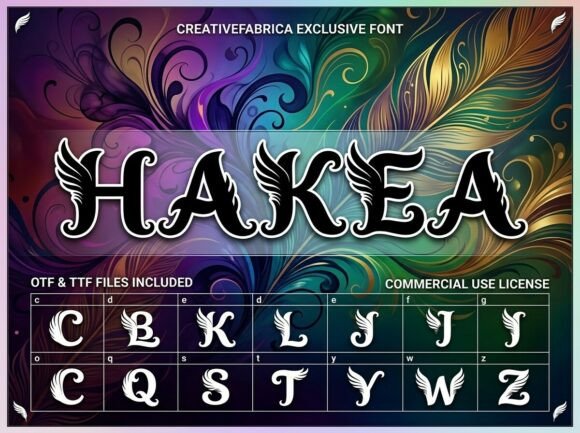
At its core, Hakea is a fusion of classical engraving and symbolic avian motifs. Its primary innovation lies in transforming the primary stems of each letter into detailed, layered wings. This is not a superficial overlay; the structure of the letterforms is fundamentally reimagined. The scrolling flourishes and intricate linework are reminiscent of historical copperplate engraving, but with a fantastical, organic twist. The result is a typeface that feels both ancient and uniquely crafted.
The font’s strength lies in its consistency of concept. Every glyph, from the uppercase A to the numeral 9, adheres to the central theme. The terminals of strokes don’t simply end; they scroll into feather-like details. This cohesion ensures that when Hakea is used, the stylistic message is clear and unambiguous. The weight and detail of the letterforms demand substantial negative space, making it unsuitable for small sizes or dense paragraphs but perfect for singular, impactful statements.
Practical Application and Audience Fit
Hakea is a specialized tool. Its value is realized in specific, high-context scenarios. Professionals who would benefit most include:
- Brand Designers and Art Directors: For projects in the luxury, spirits, or fantasy entertainment sectors. Hakea is exceptionally suited for high-end spirit labels, where it can evoke heritage and craftsmanship. Similarly, for bespoke jewelry branding, it conveys intricate artistry and value.
- Publishers and Authors: Particularly in fantasy, historical fiction, or mythology genres. Hakea can serve as the title font for book covers, instantly communicating the genre’s tone to potential readers. Its effectiveness here is high, as it avoids generic fantasy font tropes.
- Event Planners and Marketers: For themed events, such as celestial or mythical galas, Hakea on invitations and promotional materials sets a sophisticated, immersive atmosphere from the first glance.
The font is less suitable for tech startups, minimalist design, or any context requiring modern, clean, or approachable aesthetics. Its ornate nature requires careful pairing with simpler secondary fonts for any supporting text to avoid visual chaos.
Evaluating Quality, Usability, and Long-Term Value
From a usability standpoint, Hakea presents a clear trade-off between stylistic impact and flexibility. Its intricate details mean it is most effective in large display sizes. At smaller sizes, the wing details and flourishes can become illegible, merging into indistinct shapes. Therefore, its practical use is inherently limited to headlines, logos, and large-scale typographic art.
The font’s reliability is a function of its design integrity. It performs consistently across its intended applications. However, its value is not universal but project-specific. A designer might use Hakea for one key client project in a year, making it a valuable asset for that niche, rather than a workhorse font for daily use. The long-term value lies in its ability to solve a specific design problem exceptionally well—creating a sense of ancient power and sophisticated, historical charm that is difficult to replicate with other typefaces.
Strategic Considerations for Implementation
Using Hakea effectively requires a strategic approach. It should not be deployed simply for its novelty. Consider the following practical recommendations:
- Context is Everything: Ensure the project’s narrative aligns with Hakea’s mythological and classical themes. Using it for a children’s educational app would create a jarring mismatch.
- Pair with Restraint: Combine Hakea with a highly legible, neutral serif or sans-serif font for any body copy or secondary information. A simple, elegant serif can complement it without competing.
- Test for Legibility: Always mock up the intended text at the final size. Verify that the word or phrase remains legible and that the overall impression is one of artistry, not confusion. The scrolling terminals work best with certain letter combinations; some words may flow better than others.
- Consider Color and Background: Hakea’s detailed linework often presents best in a single, strong color on a clean background. Overly complex backgrounds or multi-color treatments can diminish its clarity and impact.
A potential limitation is its digital rendering. On some screens, particularly lower-resolution displays, the finest details may be lost. For digital use, testing across devices is prudent. For print, the font truly shines, as the crispness of paper can capture every nuance of the design, making it ideal for physical applications like book covers and labels.
Conclusion: A Niche Instrument for Potent Communication
Hakea is not a font for every project. It is a precision instrument designed to fulfill a specific communicative goal: to infuse a headline or logo with a palpable sense of legendary artistry, historical depth, and mythical elegance. For designers and creators working within the realms of fantasy, luxury, and ceremonial branding, it offers a unique and powerful voice. Its true effectiveness lies in its ability to make a visual statement that is both immediately striking and thematically resonant, transforming ordinary text into what feels like a crafted artifact. When applied thoughtfully and in the right context, Hakea delivers on its promise of commanding royal attention.