Retro American Aesthetics: A Practical Guide to Fonts and Creative Assets
Understanding the Core Visual Language
The term "Retro American" refers to a broad design style that draws inspiration from the mid-20th century United States, roughly spanning the 1940s through the 1970s. This era is characterized by specific typographic choices, color palettes, and illustration styles that evoke nostalgia for diners, roadside motels, vintage signage, and classic advertising. When designers seek out a Retro American font, they are typically looking for typefaces that mimic the hand-lettering of that era—styles like bold script, condensed sans-serifs, and rounded slab serifs. The distinctiveness of this aesthetic lies in its ability to communicate warmth, authenticity, and a sense of history, making it a popular choice for branding projects that aim to feel established yet approachable.
The Technical Reality: OTF vs. TTF Formats
When selecting a Retro American font, one of the first technical comparisons a user encounters is the choice between OTF (OpenType Font) and TTF (TrueType Font) formats. For the average user, the differences may seem negligible, as both formats are widely supported on modern operating systems. However, for professional designers, the distinction is significant.
TTF is an older standard that works well for basic compatibility across systems. OTF, however, is the more advanced format. It utilizes the same basic structure as TTF but includes expanded capabilities. Most notably, OTF supports advanced typographic features such as ligatures, stylistic alternates, and contextual swashes. For a Retro American aesthetic, which relies heavily on unique character connections and flourishes to mimic hand-lettering, OTF is often the superior choice. It allows for a more dynamic and authentic look without requiring the user to manually adjust spacing between every letter pair.
Digital Creation: Procreate vs. Affinity Suite
The application of these fonts depends heavily on the user's workflow, particularly when comparing Procreate for iPad users against the Affinity Suite (Designer and Photo) for desktop or tablet production.
Procreate is a raster-based illustration app favored by artists who enjoy a freehand drawing experience. When using a Retro American font in Procreate, the text is often treated as a raster layer once the canvas is finalized, or it requires specific workarounds to remain editable. It is an excellent environment for adding texture, grain, and hand-drawn imperfections to typography, which enhances the vintage feel. However, it lacks the precision of vector-based layout tools.
In contrast, Affinity Designer and Affinity Photo offer a more robust environment for typography. Affinity Designer, being vector-based, allows for infinite scalability of Retro American fonts without pixelation. This is crucial for logos or signage that may need to be resized for different mediums. Affinity Photo handles typography similarly to Adobe Photoshop, offering layer-based editing. The tradeoff is often a steeper learning curve compared to the intuitive nature of Procreate, but the gain is in non-destructive editing and precise control over the font's vector nodes.
Expanding the Toolkit: Dingbats, Doodles, and Outlines
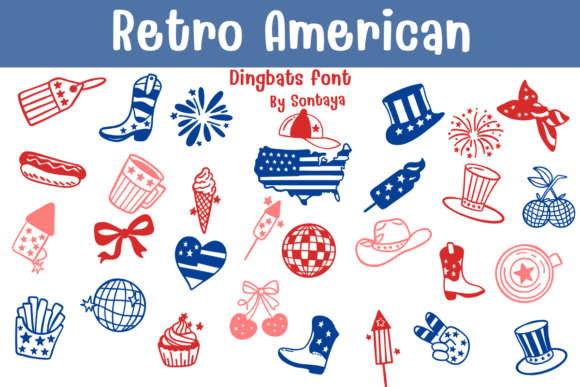
A comprehensive Retro American design system rarely consists of typography alone. To fully capture the aesthetic, designers often utilize Dingbats, Doodle elements, and Coloring Outlines. These assets provide the thematic context that grounds the typography in the era.
- Dingbats and Doodles: These are ornamental fonts or vector assets that include retro motifs like stars, arrows, swooshes, and cartoonish illustrations. They act as visual shorthand for the era. When evaluating these, look for assets that match the stroke weight of your primary Retro American font to ensure visual consistency.
- Coloring Outlines: These are vector line drawings that allow for easy color application. In a Retro American context, these are often used for creating coloring pages or flat vector illustrations that mimic the "paint-by-numbers" or simple cartoon styles of mid-century children's books and advertisements.
When combining these elements, the challenge lies in cohesion. A bold, condensed Retro American font might clash with a delicate, thin-line doodle. Therefore, evaluating the "weight" and "texture" of the dingbats alongside the font is a critical decision factor.
Evaluating Use Cases and Limitations
Choosing a Retro American style is not always the right decision. Understanding the best-fit situations is key to a successful project.
When to Choose This Style
Retro American fonts and assets are ideal for projects requiring a human touch. They excel in brewery branding, vintage apparel, restaurant menus, and event posters. The style naturally communicates "craft" and "heritage." If the goal is to stand out from the sterile, geometric sans-serifs typical of modern corporate tech branding, the Retro American aesthetic provides a strong emotional contrast.
When to Seek Alternatives
This style has limitations, particularly regarding legibility at small sizes. Highly decorative Retro American scripts or condensed display fonts can become unreadable when used for body text or mobile user interfaces. In scenarios requiring high accessibility, dense data display, or a futuristic/modern vibe, a clean sans-serif or a geometric sans-serif would be a more appropriate alternative. Furthermore, while the style is nostalgic, overusing it can make a brand look dated rather than "retro," potentially alienating younger demographics who do not share the same cultural touchstones.
Decision Factors for the Modern Designer
When evaluating resources for this style, consider the completeness of the font family. A high-quality Retro American font often includes multiple weights (Regular, Bold, Inline) and a "Pro" version with extensive OpenType features. This versatility allows the designer to create hierarchy within the text without mixing conflicting typefaces.
Additionally, consider the file ecosystem. A resource that provides the font in OTF/TTF formats alongside matching vector dingbats and Affinity/Procreate brushes offers a more efficient workflow. This reduces the time spent hunting for complementary assets and ensures that the visual language remains consistent across all design elements.
Ultimately, the decision to adopt a Retro American aesthetic should be driven by the project's narrative. If the story being told is one of tradition, craftsmanship, or playful nostalgia, these assets provide a powerful vocabulary. If the narrative requires sleek efficiency or cutting-edge innovation, exploring modern typography alternatives would be the more practical path.