The Heart of the Matter: How Playful Typography Shapes Modern Visual Communication
In the vast universe of graphic design, typography serves as the primary vessel for conveying not just information, but emotion. While serif fonts speak to tradition and sans-serifs suggest modern efficiency, there is a specific category of typefaces dedicated entirely to feeling. These are the display fonts, and among them, a distinct sub-genre has emerged that prioritizes affection and whimsy over corporate neutrality. One of the most striking examples of this trend is Glora Heart, a typeface that challenges the rigidity of standard design grids with its bulbous, soft-edged forms and intricate decorative detailing.
Understanding fonts like Glora Heart requires a shift in perspective. We must move beyond viewing text merely as a carrier of semantic meaning and start viewing it as a visual texture—a pattern that evokes an immediate psychological response before the reader even processes the words. This article explores the mechanics, psychology, and practical application of decorative, affection-themed typography in today's visual landscape.
The Anatomy of Affection: Soft Forms and Visual Weight
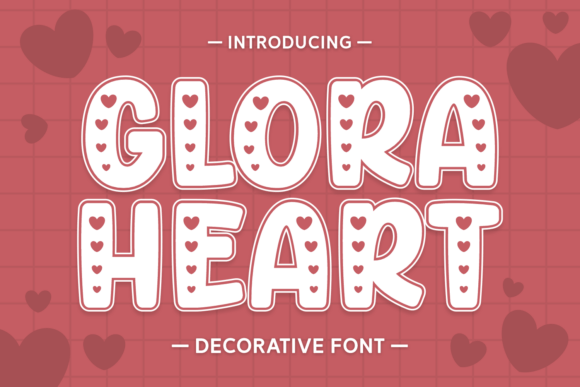
The defining characteristic of highly expressive fonts is their silhouette. Glora Heart, for instance, utilizes an "extremely chunky" and "rounded" aesthetic. In design psychology, sharp angles often trigger alertness or anxiety, whereas rounded shapes mimic the natural forms of safety—like a pebble smoothed by water or the curve of a human cheek. This is why fonts with massive, soft-edged letterforms are instantly perceived as "friendly" or "cute."
However, shape alone does not tell the whole story. The innovation in fonts like Glora Heart lies in the treatment of negative space. The interior of the letterforms—the counters—is not empty. Instead, it features a pattern of "small, cheerful heart cutouts." This detail transforms the typography from a simple block of text into a lace-like fabric. It adds a layer of texture that demands a closer look, effectively increasing the time a viewer spends engaging with the design. For designers, this texture provides a built-in graphic element, reducing the need for additional overlays or background patterns.
Psychological Impact: The "Cuteness" Factor in Design
Why do designs featuring elements like Glora Heart resonate so deeply with audiences? The answer lies in the psychological concept of "baby schema" (Kindchenschema). Humans are biologically wired to respond to features that resemble infants: large heads, round eyes, and soft bodies. Rounded, chunky typography mimics these proportions. When a viewer sees a bold, rounded font, they subconsciously register it as non-threatening and approachable.
This "cartoonish" aesthetic is not just for children; it is a powerful tool for disarming adult audiences as well. In a digital landscape often cluttered with aggressive marketing and stark minimalism, a design that feels "sweet" and "memorable" acts as a visual palate cleanser. It suggests that the content or product associated with the text is safe, enjoyable, and perhaps even nostalgic.
Practical Applications: Where Whimsy Meets Commerce
While it might be tempting to view a font like Glora Heart as niche, its utility spans a surprisingly broad range of commercial and creative sectors. The key is understanding the context of "playfulness" in business.
1. Thematic Marketing and Seasonality
The most obvious application is in event-based marketing. Valentine’s Day, Mother’s Day, and anniversaries rely heavily on visual cues of love. A font that literally embodies the heart shape streamlines the design process for greeting cards, banners, and social media posts. However, relying solely on seasonal application limits the font's potential.
2. Children’s Products and Education
In the realm of children’s products, safety and fun are paramount. Glora Heart is an excellent candidate for packaging in the confectionery sector, toy branding, or educational apps for toddlers. The "massive" nature of the font ensures high legibility, while the heart pattern adds a layer of visual stimulation that keeps young eyes engaged.
3. Casual Branding and Apparel
The fashion industry has seen a resurgence of "kidcore" and playful aesthetics. Streetwear brands and custom apparel designers often seek typography that breaks the mold of standard block letters. A font with unique internal patterning, like the heart cutouts found in Glora Heart, translates exceptionally well to embroidery and screen printing. It creates a texture that looks high-quality on fabric, making it perfect for tote bags, hoodies, and merchandise.
Technical Considerations for Decorative Typography
For professionals and hobbyists alike, integrating a heavily decorative font into a project requires technical finesse. Fonts like Glora Heart are distinct because they function as both a typeface and an illustration. Here are key considerations for implementation:
- Hierarchy and Scale: Because Glora Heart features intricate internal details (the heart cutouts), it does not scale down well. At small sizes, the cutouts will fill in, turning the text into a muddy blob. This font must be reserved for high-impact headers or display text where the size allows the details to breathe.
- Color Contrast: The "soft-edged" nature of the font means it can lose definition against complex backgrounds. It requires high contrast—either light text on a dark background or vice versa—to ensure the silhouette remains distinct.
- Kerning and Spacing: Rounded, chunky characters often trap negative space between them (the space between an 'O' and a 'C', for example). Designers must pay close attention to optical kerning to ensure the text reads as a cohesive word rather than a collection of individual bubbles.
The Evolution of "Fun" Fonts in Digital Spaces
The rise of expressive typography reflects a broader cultural shift toward authenticity and emotion in branding. For years, the "Corporate Memphis" style—flat, geometric, and strictly vector—dominated the tech world. However, audiences are increasingly seeking warmth. We are seeing a resurgence of organic shapes, hand-drawn elements, and tactile textures.
Glora Heart fits perfectly into this renaissance of warmth. It moves away from the cold efficiency of geometric sans-serifs and embraces a "high-impact, love-themed" visual punch. This is particularly relevant for businesses looking to build communities rather than just customer bases. A playful typeface signals that a brand does not take itself too seriously and values connection over perfection.
Beyond the Obvious: Unexpected Pairings and Uses
To truly master the use of a font like Glora Heart, one must think beyond the standard "love" themes. Here are a few advanced use cases:
- Contrast Pairings: Pair Glora Heart with a strict, monospaced typewriter font. The juxtaposition of the "cheerful" and the "technical" creates a trendy, eclectic vibe often seen in independent zines or avant-garde web design.
- Abstract Art: Because the letterforms are so "uniquely adorned," they can be used as abstract shapes. Zooming in on a single letter of Glora Heart can create a repeating wallpaper pattern or a background texture for a website that feels organic and soft.
- Signage with Personality: Small businesses, such as bakeries or flower shops, often struggle to stand out. Using Glora Heart for menu headers or "Open/Closed" signs can inject personality into the physical space, making the environment feel curated and welcoming.
Conclusion
Typography is the voice of design. While some projects require the whisper of a light sans-serif, others demand the enthusiastic shout of a display font. Glora Heart represents the pinnacle of affectionate design—combining massive, soft forms with intricate, cheerful details to create a visual experience that is impossible to ignore. For designers, educators, and business owners, understanding how to harness the power of such playful typography is key to creating work that connects on a human level. Whether for a Valentine’s card, a children’s book, or a bold branding project, the right font doesn't just display words; it displays intent.