Bisma: Integrating a Hand-Crafted Floral Typeface into Professional Design Workflows
In the landscape of graphic design, typography serves as the bridge between content and visual emotion. While standard sans-serifs and serifs handle the bulk of functional communication, specialized display fonts carry the weight of branding and thematic storytelling. Bisma occupies a specific and valuable niche within this ecosystem. It is not merely a typeface but a collection of intricate botanical illustrations arranged as letterforms. Understanding how to categorize, prepare, and deploy such a detailed asset is crucial for designers, marketers, and creators aiming to produce high-quality visual content without compromising project efficiency.
Characterizing the Asset: Beyond Standard Typography
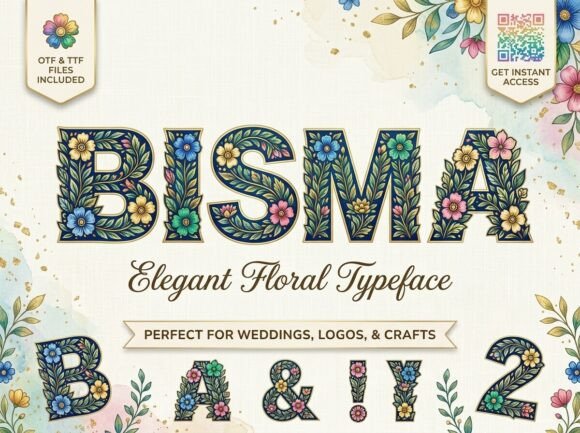
Before integrating Bisma into a project plan, it is necessary to understand its technical and aesthetic composition. The typeface is characterized by its dense vector detailing. Each character functions as a standalone piece of art, woven with vibrant flowers, lush green leaves, and delicate golden vine work. This intricate construction distinguishes it from standard script fonts which rely on simple bezier curves.
From a production standpoint, Bisma falls under the category of "heavy" vector assets. Because of the high node count required to render the floral details, using this font requires consideration regarding file size and rendering performance. It is designed primarily for display use—headlines, logos, and invitations—rather than body copy. Its aesthetic is strictly defined: romantic, ethereal, and boutique. Consequently, it is best suited for projects that require an immediate connection to nature, elegance, or artisanal craftsmanship.
Strategic Planning and Project Scoping
Effective implementation of Bisma begins long before the design phase. It starts during the strategic planning or mood boarding stage. When a project brief calls for a "botanical aesthetic" or a "romantic atmosphere," Bisma should be identified early as a primary asset. This early identification allows for the adjustment of surrounding design elements to accommodate the font's complexity.
Consider the hierarchy of the design. Because Bisma is visually dense, it creates a "high texture" environment. Planning for this means allocating space in the layout for the letters to breathe. If the design plan involves a cluttered background, the legibility of Bisma will degrade. Therefore, a practical workflow step involves selecting complementary assets—such as solid geometric sans-serifs for body text and high-contrast or muted backgrounds—that allow the floral details of Bisma to remain the focal point.
Workflow Integration: Preparation and Setup
Integrating Bisma into a professional workflow requires specific preparation steps to ensure compatibility and efficiency. The process differs slightly depending on the software environment, whether it be Adobe Creative Cloud, Affinity Designer, or web-based platforms like Canva.
File Preparation and Software Compatibility
Upon acquiring the font files, the immediate step is installation and organization. For teams, this involves syncing the font across shared libraries to prevent "missing font" errors during collaboration. It is advisable to test the font's rendering in vector software immediately. Because of its intricate vine work, Bisma may occasionally require manual adjustment of kerning (the space between characters) to ensure that the vines of one letter do not awkwardly clash with the flowers of the next.
When working in vector environments, designers should be prepared to convert the text to outlines (vector paths) for final output. However, it is best practice to keep a live text layer preserved until the final approval stage. This allows for last-minute copy changes, which is vital in client-facing workflows where text revisions are common.
Color Palette and Texture Management
The "golden vine work" inherent in Bisma’s design suggests a warm color palette. During the implementation phase, designers should experiment with color application. While the font renders well in monochrome (black or white), utilizing a multi-tone approach can elevate the design. For instance, using a deep forest green for the leaves and a soft gold for the vines can be achieved through layering or, if the font file supports it, through OpenType features or color font standards.
However, altering colors within a complex font can be time-consuming. A more efficient workflow involves treating the font as a silhouette. If the project timeline is tight, applying a solid, high-contrast color to the entire character often yields a cleaner, more professional result than attempting to manually color individual botanical elements.
Practical Use Cases and Execution
The versatility of Bisma allows it to be deployed across various stages of a project lifecycle, from the initial concept to the final deliverable.
Application in Stationery and Print
In the context of wedding invitations or boutique packaging, Bisma acts as the primary brand identifier. The workflow here involves creating a "lockup"—a fixed arrangement of the logo or headline. Once the lockup is established using Bisma, it can be treated as a graphic element rather than text. This is a critical efficiency tip: by vectorizing the specific arrangement of Bisma for a logo, the designer ensures that the intricate floral details remain consistent across all print materials, from business cards to large-format banners.
Digital Marketing and Social Media
For digital marketers and bloggers, Bisma serves as a powerful tool for creating "thumb-stopping" visuals. In a fast-scrolling environment, the texture of the floral letters creates immediate visual interest. The implementation process here involves pairing Bisma with clean, modern layouts. A practical example is using Bisma for the main hook of a social media graphic while using a sans-serif font for the call-to-action. This contrast ensures readability while maintaining the aesthetic appeal.
Branding and Logo Design
For entrepreneurs and small business owners, selecting a typeface for a logo is a long-term decision. Bisma is ideal for brands in the floristry, wedding planning, or artisanal goods sectors. However, a quality control check is necessary. Designers must ensure that the logo remains legible when scaled down to a favicon (the small icon in a browser tab) or a social media profile picture. Because of its high level of detail, Bisma may lose definition at very small sizes. A robust workflow includes testing the font at various scales and potentially creating a simplified version of the logo for small-scale applications.
Optimization and Quality Control
Finalizing a design featuring Bisma involves a rigorous quality control process. The primary concern is file optimization. Because the vector paths are complex, exporting to web formats (SVG or PNG) can result in large file sizes that slow down website loading times.
To mitigate this, designers should use optimization tools to simplify the vector paths without losing visual fidelity. This process, known as path simplification, reduces the number of anchor points in the floral details. When exporting for web, running the assets through compression tools ensures that the aesthetic quality of the font does not negatively impact the site's performance or SEO rankings.
Conclusion
Bisma is more than a decorative element; it is a specialized tool that, when used correctly, can significantly elevate the perceived value of a project. By understanding its technical requirements, planning for its visual weight, and integrating it into a structured workflow, creators can leverage this floral typeface to produce professional, memorable, and cohesive designs. Whether used for a single invitation or a comprehensive brand identity, the key to success lies in balancing its intricate beauty with practical execution and optimization.